

Stop Running Businesses. Start Managing a Portfolio.
Isolate risk, centralize management, and optimize your tax footprint.
Meet our Resident Wealth Mastery Coach, Victor, ready to work with you to design and deploy your own custom Holding Company structure that turns scattered businesses into a unified, scalable empire.
The “Victor” Philosophy: The 2026 Power Move
“Most Kenyan entrepreneurs stop at one LLC. But if your operating company gets sued, your entire life’s work is at risk. By 2026 standards, the only safe way to grow is the Parent-Subsidiary model: The Holding Company owns the assets; the Operating Company takes the risks.” — Victor Isyamba
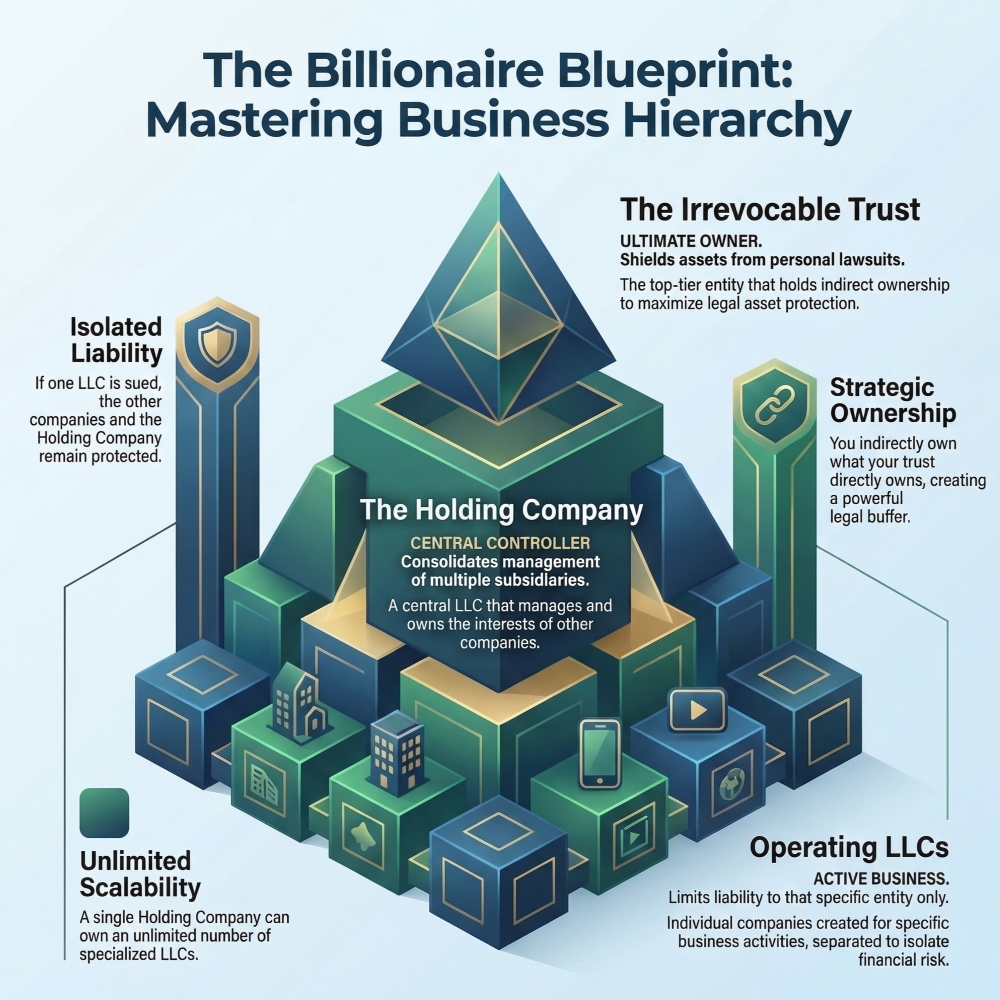
Holding vs. Operating: Know the Difference
| Feature | The Holding Company (Parent) | The Operating Company (Subsidiary) |
| Primary Goal | Asset Ownership & Control | Daily Business & Trade |
| Risk Profile | Low (Does not trade) | High (Interacts with public/debt) |
| Assets Held | IP, Real Estate, Excess Cash | Inventory, Equipment, Leases |
Key Benefits of This Structure
- Risk Ring-Fencing: If one operating company fails or faces a lawsuit, the assets held in the Holding Company remain untouchable.
- Centralized Management: Use one “Management Company” to handle HR, Finance, and Brand Marketing (like your Fractional CMO services) for all your subsidiaries.
- Tax Optimization: Move profits from an “Operating Company” to the “Holding Company” as dividends (often at a lower tax rate than personal income) to reinvest in new ventures like Agroforestry.
- Exit Strategy: It is much easier to sell one specific subsidiary while keeping your brand and core assets within the Holding Company.
Implementation: The BRS V2 Process (2026 Update)
We don’t just tell you why; we show you how.
- Entity Mapping: We determine which existing companies become subsidiaries.
- Share Swaps & Transfers: Legally moving ownership to the Parent entity.
- Board Governance: Setting up the management protocols for your group.
- KRA Group Compliance: Ensuring beneficial ownership (BOF1 forms) are correctly filed on eCitizen to avoid the 2026 transparency penalties.
The Pricing Strategy: The Mastery Tiers
We don’t bill like a lawyer; we bill like an Architect. These are “Flat-Fee” project bundles to give you cost certainty.
Tier 1: The Discovery Audit (The Entry Point)
- Target: Entrepreneurs, families, or individuals with scattered assets.
- Deliverable: A comprehensive KYC “Wealth Health Check” & Structural Roadmap.
- Price: KES 75,000-150,000
- Timeline: 1 week.
Tier 2: The Fortress Build (The “Best Seller”)
- Target: Established leaders needing a full reset.
- Deliverables: * Formation of 1 Family Trust and 3 Paper Assets (LLCs).
- Restructuring of 1 Holding Company.
- Succession & Tax Optimization Plan.
- Price: KES 350,000 – KES 500,000 (depending on asset complexity).
- Timeline: 6–16 weeks.
Tier 3: The Sovereign Legacy (The Bespoke Option)
- Target: Multi-generational families and HNWIs.
- Deliverables: Full “Wealth Mastery” ecosystem including global structures Family Constitution, and ongoing Fractional Wealth Strategy.
- Price: Custom Quote (Starting at KES 1,500,000).